
“AI-first” sounds smart and strategic. But in many cases, it simply means: we added a chatbot.
That’s a problem because people trust it anyway. They accept whatever an AI tool says as truth and base purchasing decisions, menu builds, and costings on outputs that may be built on thin air.
Across the restaurant tech landscape, AI is often a feature bolted onto existing software. There’s a new tab, a flashy demo, but lift the hood, and nothing has changed.
The data underneath is still a mess. So the intelligence layer does what any model does when it lacks a foundation: it fills in the gaps with guesses and fabrications.
Restaurant groups invest serious money in these tools. In return, they expect smart forecasting and less manual work. Instead, they get unreliable insights that still need heavy cleanup.
Make no mistake, the potential of AI for foodservice is genuinely staggering, but this industry is challenging enough without professional-looking lies making things worse.
So how do you align your restaurant technology strategy with artificial intelligence?
This article breaks down three principles of AI-first restaurant systems.
1. AI Is Only as Good as the Data Behind It
One of the most persistent misconceptions about AI is that intelligence comes from algorithms. It doesn’t. It comes from data quality.
AI is often framed as magic, as if it can do everything.
It can do impressive things, but strip away the hype, and AI is software. Powerful software that can process large amounts of data, spot patterns people miss, and suggest actions based on context.
But it doesn’t have intuition or judgment.
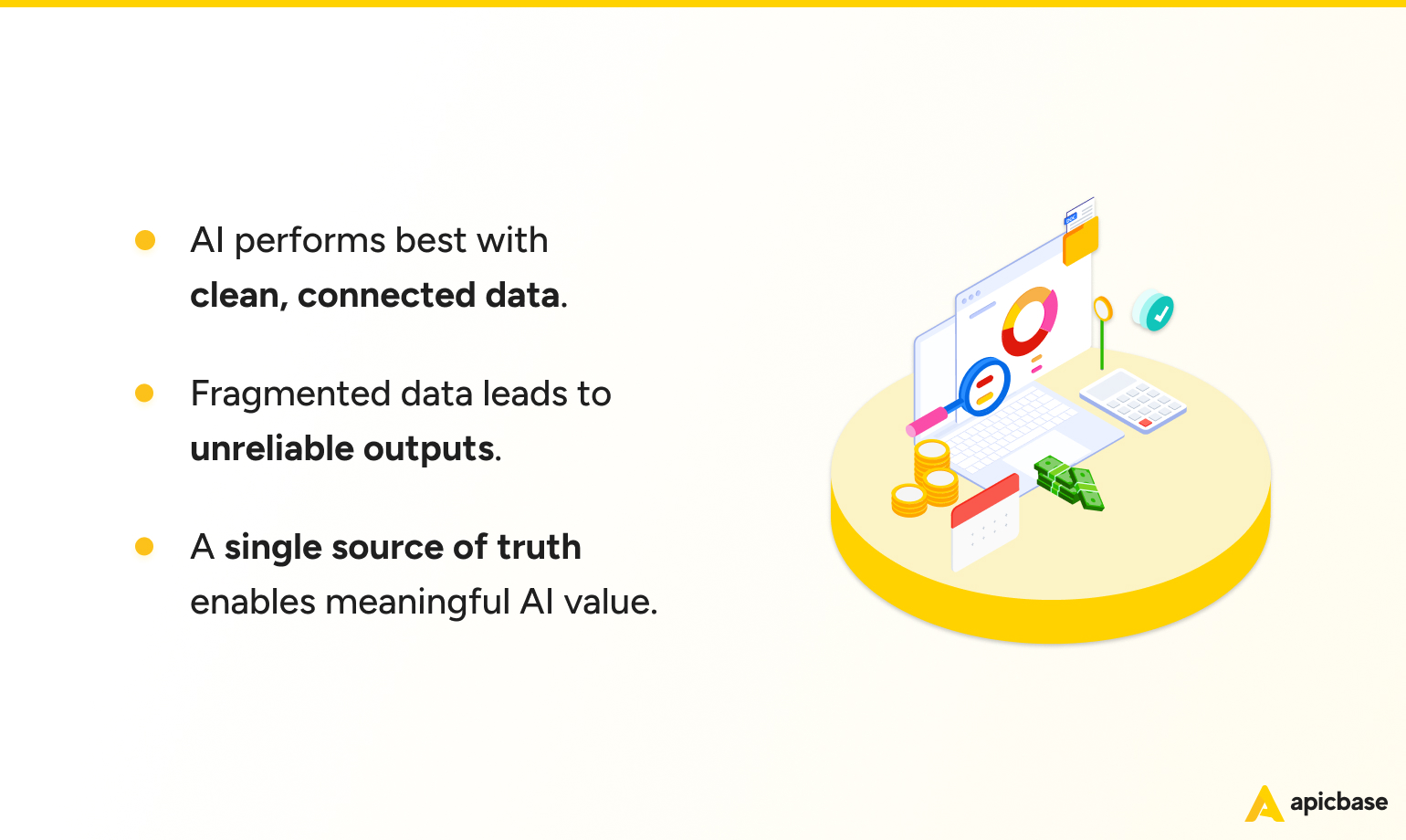
What it does well is reduce manual work and speed up routine decisions. When data is clean, consistent, and structured, AI models perform well. When it’s not, the system is forced to guess or hallucinate.
AI can only reason with what it understands. If it’s working with messy, incomplete, or inconsistent data, its outputs will reflect those flaws.
In foodservice operations, that situation is more common than many would care to admit.
For example:
- The same ingredient may be entered under multiple names across different locations.
- Recipes may list vague quantities — a bag, a crate, a portion — without defined units.
- Supplier prices may be outdated or updated too late to inform decision-making.
- POS data may reside in one system and inventory in another, with no reliable connection between them.
Individually, these inconsistencies seem minor. Collectively, they create a fragmented data environment in which no AI system can operate reliably.
Before AI can deliver meaningful value, there must be a common language: defined ingredients, standardised units, and consistent costing logic.
It’s not glamorous work, but it is foundational — the backbone of any scalable foodservice operation.
That’s precisely why Apicbase was built the way it was. From the start, it has been structured around clean data and operational clarity.
In Apicbase, ingredients, recipes, suppliers, costs, allergens, and nutritional information all live in one centralised, structured system with a shared operational logic. Each element has a single source of truth. Units remain consistent. Calculations behave predictably, regardless of who is using the system or where.
That alignment is what makes AI work, instead of confidently filling the gaps with professional-looking lies.
2. AI Should Remove Friction
In hospitality, the challenge is not a lack of tools. It’s the friction between them.
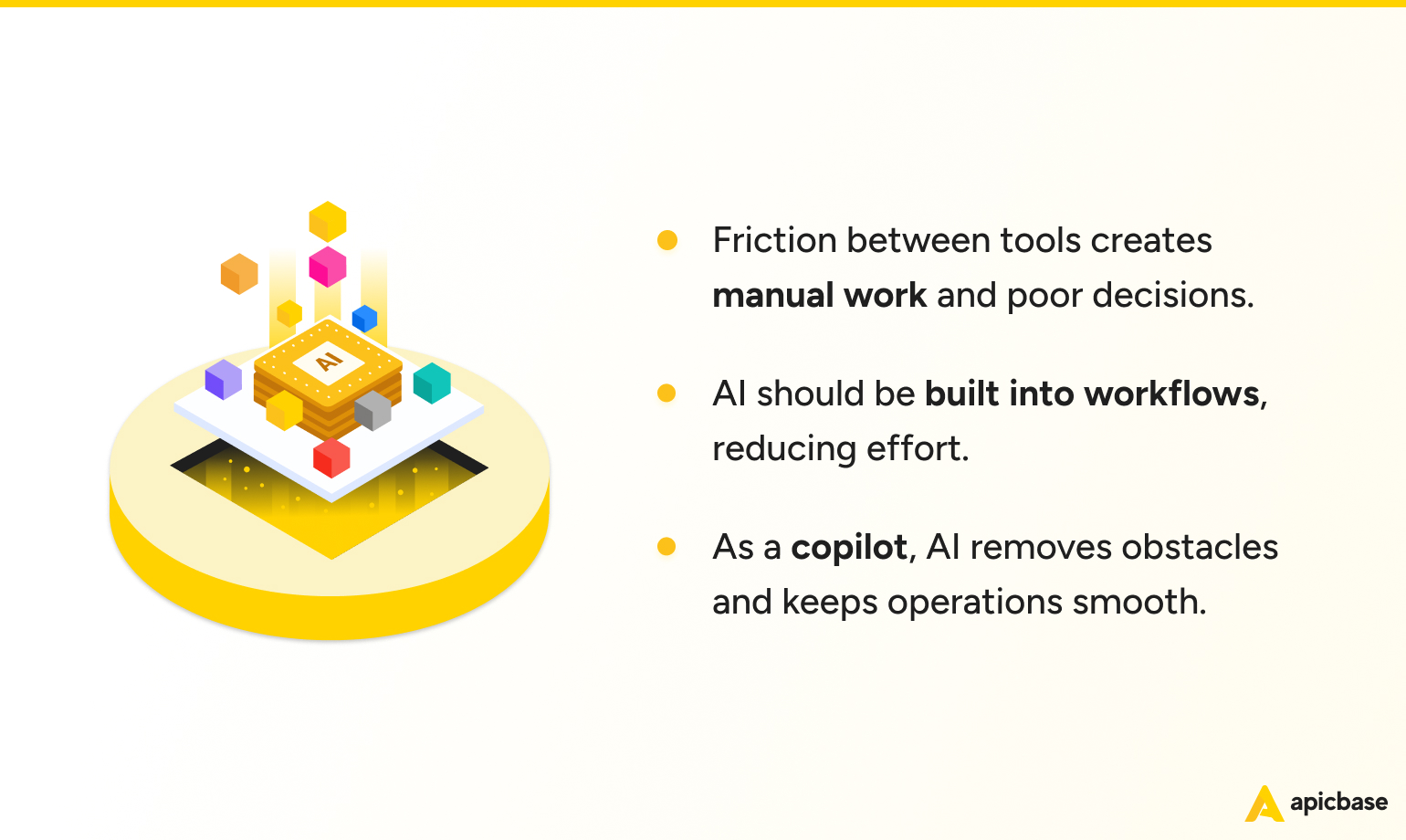
Teams spend hours re-entering the same data across multiple systems, exporting information into spreadsheets for manual analysis, and tracing the source of errors.
Staff become frustrated, and decisions get made on incomplete information.
We believe AI should absorb that friction.
An AI-first system shouldn’t require teams to change how they work. It shouldn’t demand that people consciously “start using AI”, prompting their way through issues or building personal agents to patch operational gaps.
In practice, those individual workarounds just introduce further inconsistency. Instead, intelligence should be embedded directly into existing workflows, reducing effort without requiring additional attention.
Consider the small, daily frustrations:
- Manually entering data field by field when importing recipes or ingredient lists.
- Chasing missing allergen information to stay compliant.
- Comparing multiple spreadsheets simply to produce a basic weekly forecast.
These inefficiencies pull chefs and managers away from the kitchen and into administration.
At Apicbase, we think of AI as a copilot. It manages routine processes in the background, keeps operations running smoothly, and only surfaces when attention is actually needed.
That’s how we design Apicbase AI: to lighten the load, accelerate decisions, and support teams without becoming another thing to manage.
This matters even more in environments with high staff turnover. When experienced employees leave, institutional knowledge leaves with them — and the team left behind rarely has time to train replacements from scratch.
A reliable copilot closes that gap. New hires become productive faster, and daily operations don’t stall while they catch up.
That’s what it means for AI to remove friction: your restaurant teams simply hit fewer walls throughout their day.
3. AI Needs an Open Data Architecture
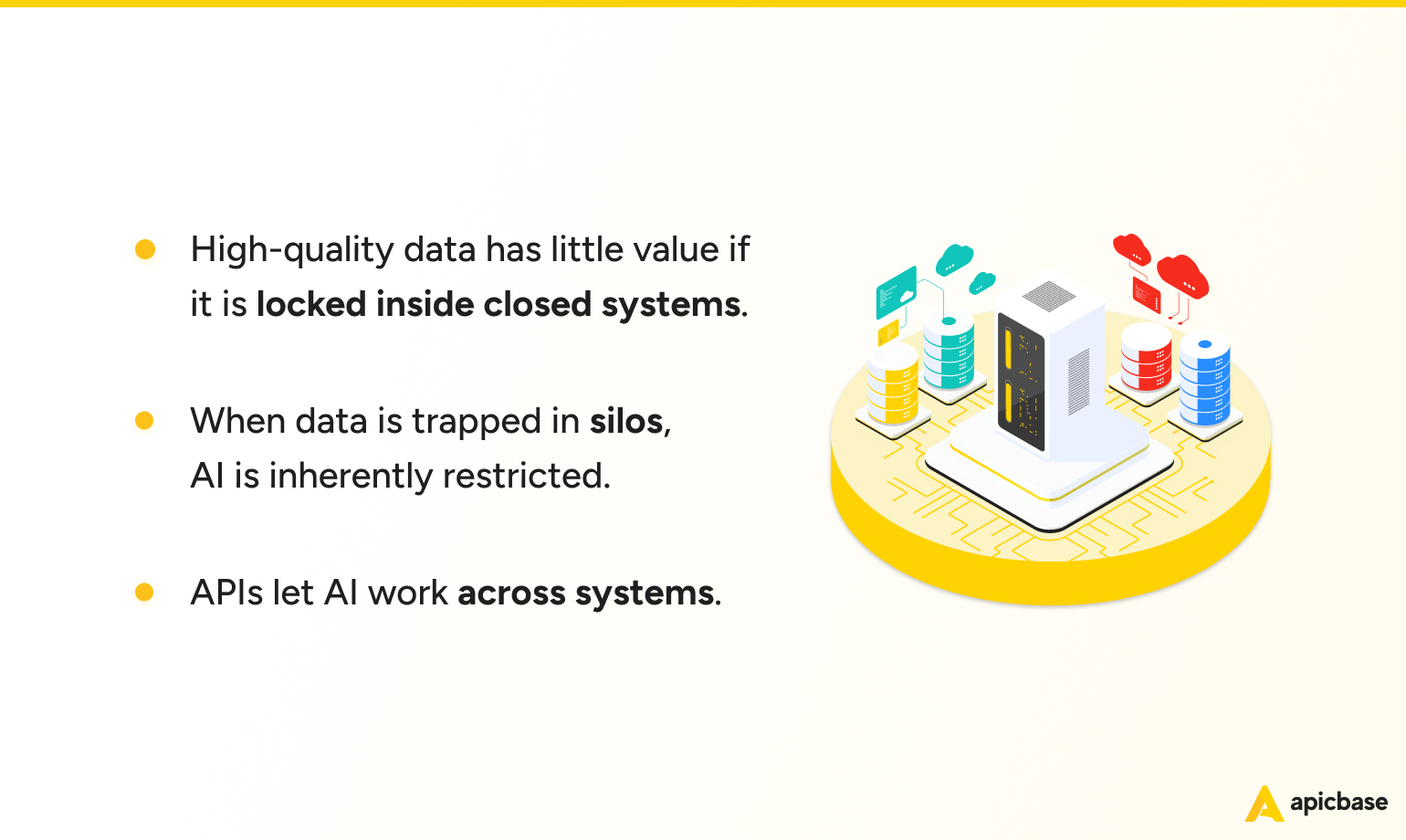
Even the highest-quality data holds little value if it’s locked away.
Yet that’s precisely the situation in many restaurant software systems. They’re built as closed environments: data goes in, reports come out, but only within the narrow confines of that specific platform.
Think of legacy POS systems, supplier ordering platforms, or ERP systems that were never designed for foodservice in the first place.
If operators want to analyse or apply their data elsewhere, they’re forced to export it to spreadsheets, clean it manually, and upload it again.
Closed systems don’t just limit what restaurants can do with their own data; they also limit what AI can do with it. When information is trapped in silos, intelligence is trapped too.
At Apicbase, we’ve taken a fundamentally different approach. Our platform is open by design.
From the outset, we built Apicbase on the principle that operational data belongs to the restaurant, not the software provider.
Data within Apicbase is clean, structured, and accessible. Our API is well-documented, enabling integration with other tools, platforms, and teams. That means a restaurant group can connect Apicbase to its POS, its procurement system, or its BI tools — and AI can work across all of them, not just within one.
In an AI-driven future, competitive advantage will come from who controls the data and how freely it can move. Apicbase was designed with that future in mind.
How Strong Is Your Data Foundation?
AI will become a standard component of restaurant technology, much like cloud infrastructure or Wi-Fi. The question is no longer whether to adopt it, but how well it will perform once you do.
That fundamentally changes the role of IT in hospitality. It’s no longer just about keeping systems running — it’s about making sure the data behind those systems is ready for artificial intelligence.
The greatest mistake you can make right now is adopting “smart” tools without first ensuring your data can support them.
That means:
- A common data language: structured, consistent, and connected across your operation.
- Embedded intelligence: AI that works within your workflows, not on top of them.
- Open architecture: so information flows where it’s needed, not where one vendor allows it.
Over the coming years, competitive advantage in foodservice won’t come from layering on more systems. A best-of-breed strategy — where each tool does its job exceptionally well — remains the most effective approach. But the real differentiator is this: how strong is your data foundation?
Without it, even the most advanced AI will fall short.

Build the AI Foundation First
Powerful AI requires clean, structured, connected data. See how Apicbase gives restaurant groups the foundation for intelligence to work.