

AI tools are cheap and powerful. Everybody uses them. But in foodservice, the results are often disappointing. The restaurants getting the most value from AI don’t have better tools. They have better data.
This article explains how to make AI work across a multi-site restaurant operation.
Foodservice has too many facts living in the wrong place
Restaurants have plenty of data, but it’s scattered across spreadsheets, WhatsApp messages, and staff memory. When AI runs on fragmented information, it has to guess, and it sounds convincing even when it’s wrong.
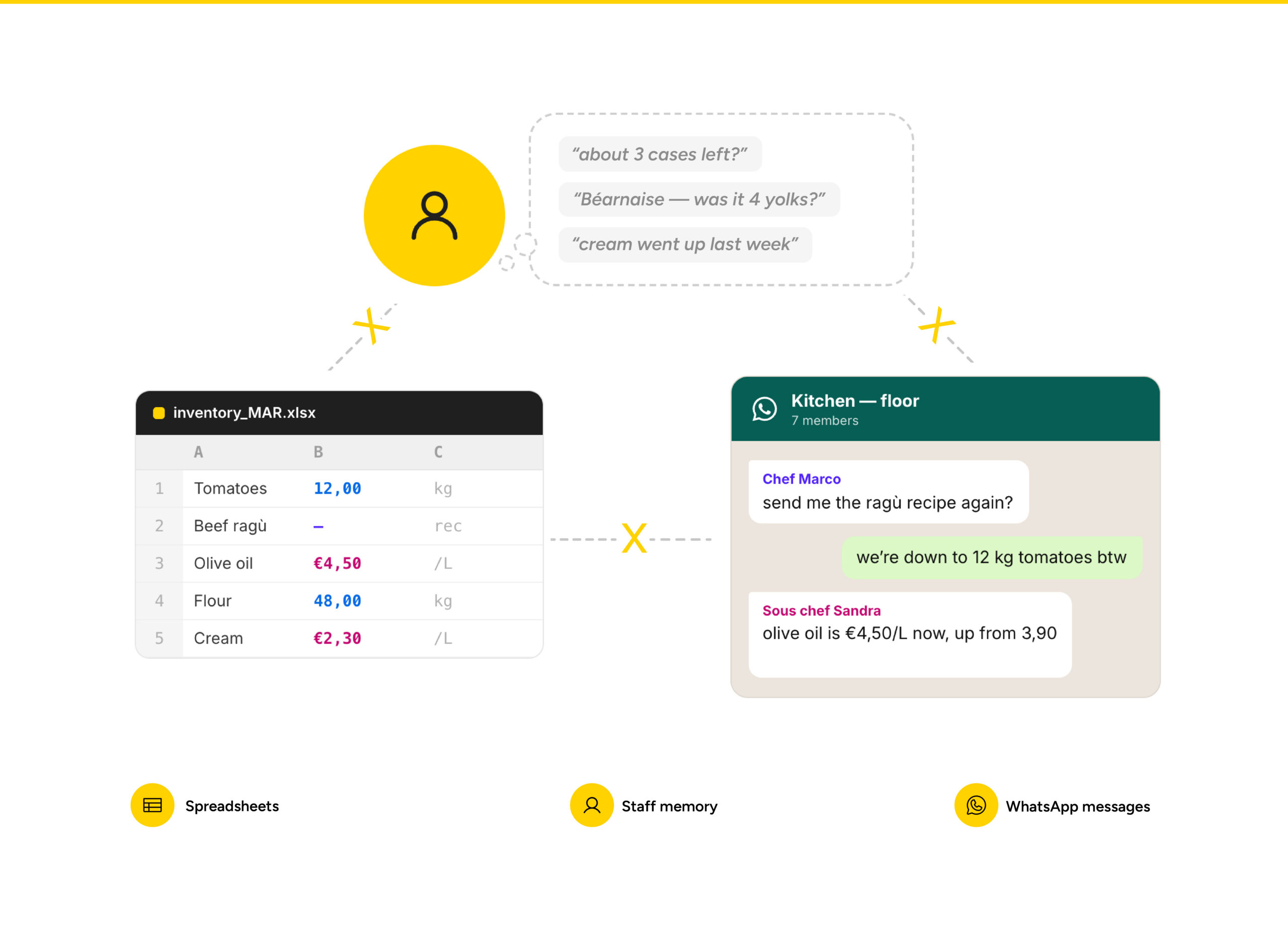
A lack of data has never really been the problem in foodservice. The challenge is where that information lives.
A pack size changes, but it’s only visible on an invoice. A chef knows about a substitute ingredient, but the central system does not. A recipe has local site variations that exist only in a spreadsheet or in someone’s memory.
These are all operational facts. But they get passed around the business through spreadsheets, emails, WhatsApp messages, handwritten notes and staff memory.
At a single site, that’s usually manageable. Across 40, 80 or 300 sites, it becomes a major headache. Not only do these data silos and workarounds make restaurant operations feel like a black box, they also create a ripple effect of inaccuracies.
Take the back of house as an example.
A change in pack size affects recipe costs → recipe costs affect menu margins → supplier substitutions affect purchasing → which affects stock levels, allergen tracking and product consistency.
The business still has the data somewhere, but it loses a reliable version of reality: what a product actually is, what a recipe really contains, or which supplier price is correct.
And that’s where AI starts to become risky.
AI works best when it has access to connected, trustworthy operational data.
McKinsey’s research highlights this point clearly. When information is scattered across disconnected systems and informal processes, AI has to bridge the gaps itself. In other words, it has to make assumptions. Sometimes those assumptions are right. Sometimes they aren’t.
For example, an AI assistant might report that food costs increased because supplier prices went up. That sounds plausible. But if key records are missing, it could completely miss the real drivers, such as recipe changes or inconsistent waste recording.
The challenge is that AI sounds very convincing even when it’s wrong.
For leadership teams, that’s a genuine risk. AI doesn’t magically fix fragmented F&B operations. And because people often trust the answers it gives, there’s a risk they’ll take them at face value, even when they can’t see how the AI arrived at its conclusions.
Facts need software
AI is great at interpreting and explaining, but it’s the wrong tool to hold basic facts like recipe costs or allergens. Traditional software follows fixed rules and gives the same answer every time. You need both: software to keep the records, AI to make sense of them.
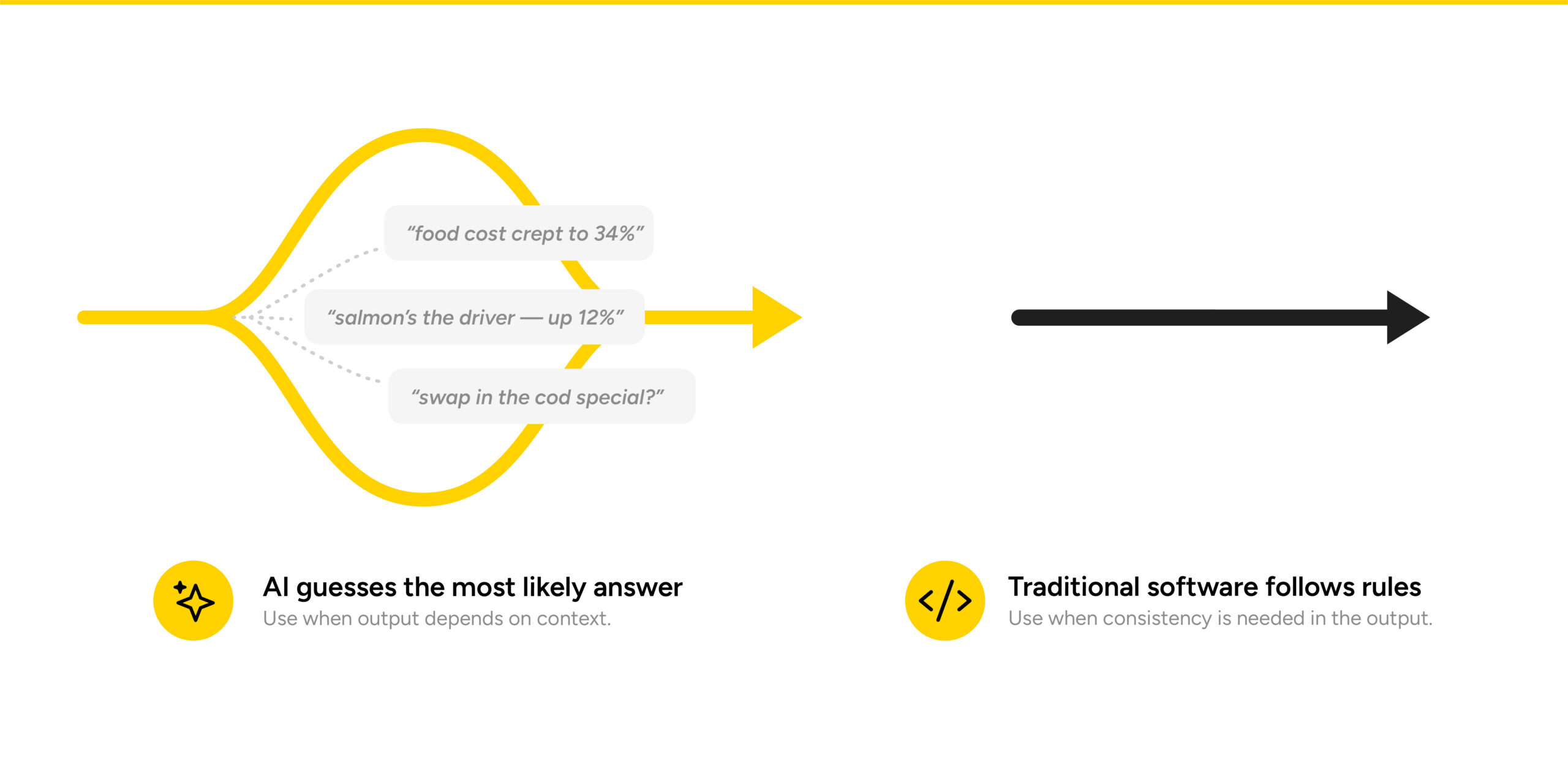
AI is brilliant at analysis. It can spot patterns, explain variances and surface insights that would take humans far longer to uncover. But it won’t magically know a product ID unless it already has access to the right source of truth.
Every business runs on facts. They need to be stable, consistent and verifiable.
In foodservice, products have pack sizes, ingredients have costs, and menu items have allergen data. Those details need to be correct every time, without ambiguity or guesswork. An allergen flag can’t change because someone phrased a question differently.
But that’s not how AI works.
AI is designed to interpret language, patterns and context. That’s what makes it so powerful for understanding and explaining what’s happening. But it also makes it a risky authority for maintaining core operational records.
Traditional software, on the other hand, is built exactly for that.
If a software system is asked for the cost of a recipe, it doesn’t make an educated guess. It follows a set of predefined rules and calculations to produce a consistent, repeatable answer every time.
That’s why AI and traditional software solve different problems, and why they play different roles in AI-first restaurant technology stacks. Software maintains the record. AI helps people understand what the record means.
That doesn’t mean AI has no role in managing data. Quite the opposite. It can read invoices, suggest product matches, identify anomalies and highlight issues that deserve attention. But those outputs should sit within a rules-based system that validates and governs the data. AI can help maintain information; it shouldn’t be the ultimate authority on it.
The quality of AI’s insights will always depend on the quality of the underlying data.
And that’s where many operators face a challenge. According to a Deloitte survey of restaurant executives, 73% plan to increase investment in AI, yet fewer than one in five believe they have the governance infrastructure in place to support it.
In other words, many businesses are investing in the engine before they’ve finished building the road. Without trusted operational data, even the most sophisticated AI can only analyse an incomplete picture. The result isn’t necessarily better decisions, it’s faster decisions based on uncertain information.
What does governed data mean?
Governed data means business terms and metrics are standardised, so everyone uses the same definitions. Access is controlled, so only authorised users can view or edit sensitive information. The organisation can trace where data came from and how it changed. And errors, duplicates, and inconsistencies are caught and corrected.
Data hubs with interchangeable AI
Restaurant operations are too complex for one system. Every business unit need a specialist platform that connects through APIs. AI sits on top of that stack. AI models will come and go. Data lasts. If the data architecture is reliable, you can replace the AI without disrupting the business.
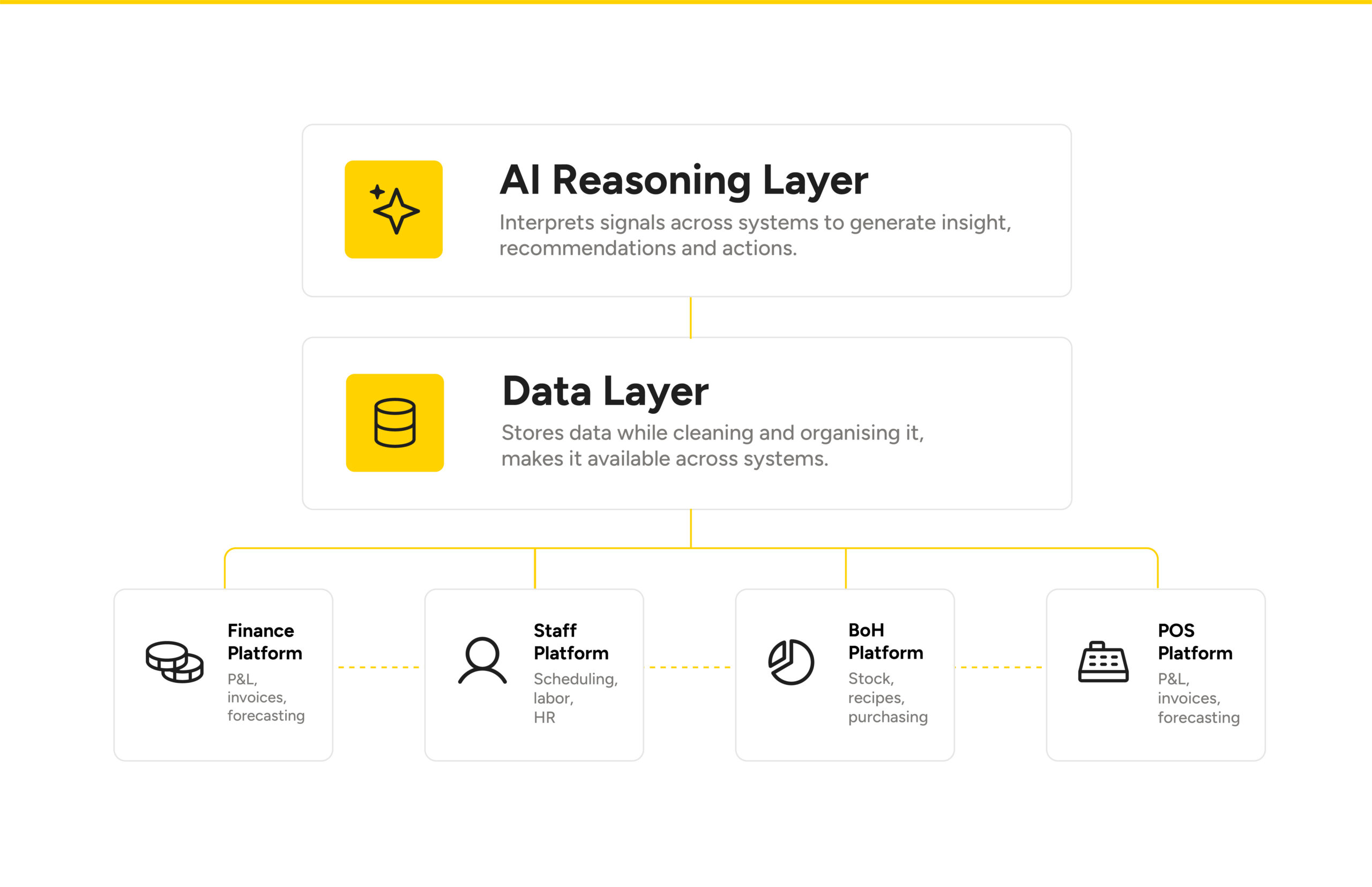
If operational information is scattered across disconnected systems, spreadsheets and staff knowledge, the obvious question is: where should that information actually live?
The answer isn’t one giant system.
Modern foodservice businesses work best with a connected set of specialist platforms, each responsible for a specific business domain, and governing the data it understands best.
Finance systems govern financial data. Workforce management platforms handle labour and scheduling. CRM systems manage guest information. And the back of house needs its own operational platform, such as Apicbase, that understands how recipes, stock, waste, purchasing and margins relate to each other.
When these systems are connected, AI can sit above them as a reasoning layer.
This approach is known as best-of-breed architecture. Instead of forcing every business function into a single platform, restaurant operators use specialised systems that share information through APIs. Each system does what it does best while contributing to a broader, connected technology ecosystem.
For larger hospitality groups with more complex technology stacks, information from these operational systems is often consolidated into a data lake or data warehouse.
This creates a three-layer technology stack:
- Application layer
This is where day-to-day operations happen.
It includes systems such as F&B management software (Apicbase), POS platforms, workforce planning tools and finance systems. These applications run workflows, enforce business rules, and create and update operational records. - Data layer
This is the organisation’s central repository for information.
Data from operational systems is collected, stored and organised in a data lake or data warehouse, creating a consistent foundation for reporting, analysis and decision-making. - AI layer
This layer sits on top of the data.
AI can interpret context, identify patterns, generate predictions, summarise information, recommend actions and answer questions. Rather than maintaining records itself, AI uses trusted operational data to help people understand what’s happening and what to do next.
Perhaps the most surprising part of this architecture is that choosing the AI tool is often the easiest decision.
Claude, Copilot, ChatGPT, Gemini, Mistral and others are all capable, affordable and easy to adopt. The real challenge isn’t selecting a model, it’s ensuring the data behind it is accurate, connected and trustworthy.
The models themselves will continue to evolve. New providers will emerge, capabilities will improve and costs will change. Businesses should have the flexibility to switch between AI providers as the market develops.
What shouldn’t change is the quality of the underlying data.
That foundation needs to remain reliable, structured and governed regardless of which AI model is analysing it.
Ultimately, restaurants need systems that reflect how they actually operate.
When operational data is managed in the right systems and connected across the business, both people and AI can work from the same version of reality. And that’s what turns AI from a hype technology into a genuinely useful one.
Why not one big system that does it all?
Big ERPs like SAP work for retail. Foodservice is different: ingredients get transformed into recipes, prepped items go back into stock, and dishes deplete inventory in complex ways. That needs a system built for restaurant logic.
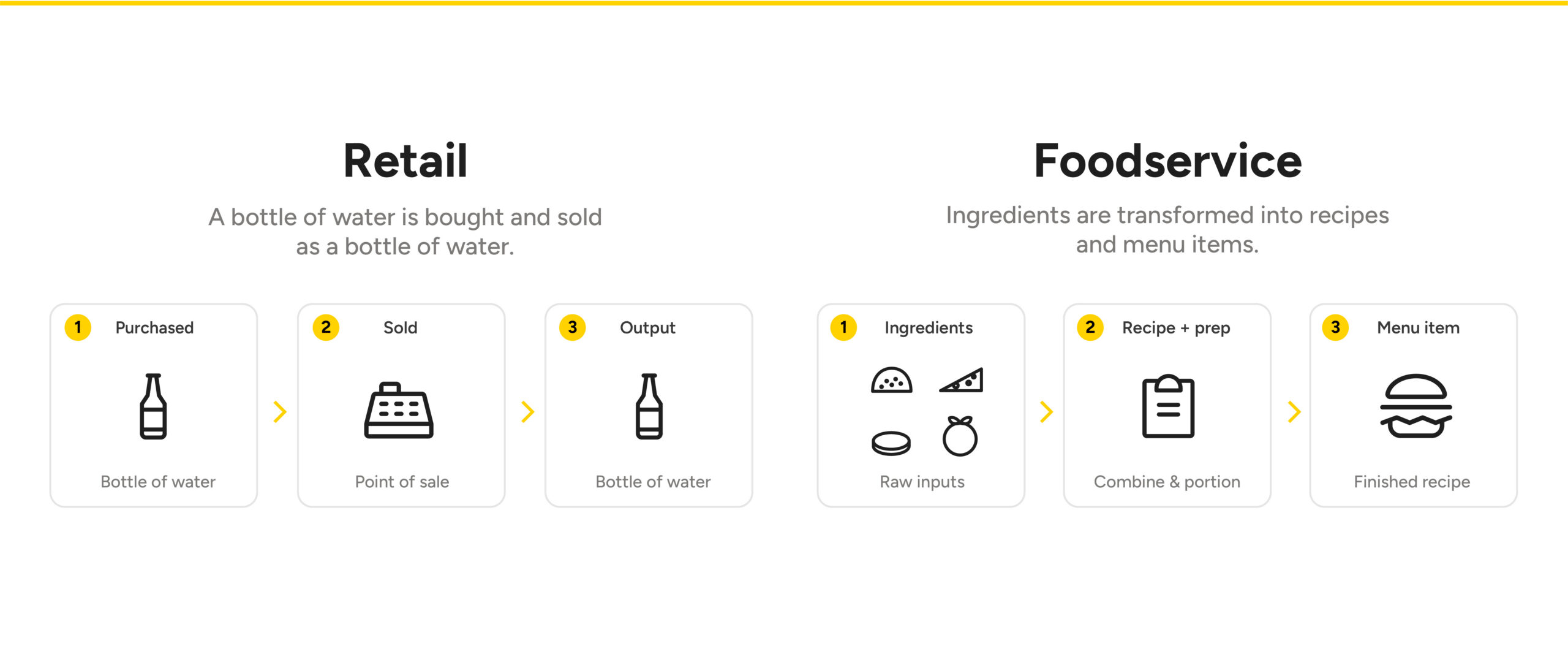
At first glance, it seems logical that large restaurant groups would centralise everything in a single enterprise system such as SAP or Oracle NetSuite. A single platform promises fewer data silos, simpler vendor management and one place to manage information.
Yet, according to McKinsey, many enterprise organisations are moving away from that approach.
Why is that?
Because foodservice has a level of operational complexity that generic ERP systems were never designed to handle.
In retail, products are typically bought, stocked and sold as the same item. A supermarket buys a bottle of water, stores it and then sells that same bottle of water. The inventory flow is relatively linear, and ERP systems are extremely good at managing it at scale.
But, foodservice operates very differently.
Ingredients are constantly transformed before they reach the customer.
A case of tomatoes might be received into stock, turned into tomato sauce, returned to inventory as a semi-finished product, used across multiple recipes and then depleted again as dishes are sold.
The same ingredient can move through several stages of production before it ever appears on a guest’s plate.
Managing that process requires a fundamentally different operational model inside the system.
The system needs to understand recipe hierarchies, production workflows, yield calculations, waste, substitutions, prep processes, inventory movements and purchasing relationships. That’s a lot more than just financial transactions and stock transfers.
This is why software with specific domain expertise matters.
While it was as an operational concern at first, it became an AI condsideration, too.
As Gartner has noted, poor data quality and weak data foundations remain among the leading reasons AI initiatives fail to deliver value. If a business lacks the systems needed to capture and govern the realities of kitchen operations, AI has little chance of producing reliable insights.
Can’t MCP solve this?
No. MCP (Model Context Protocol) gives AI tools like ChatGPT and Copilot a secure way to access external data. Apicbase provides an MCP, so users can query sales, inventory, and purchasing data directly from those tools.
The MCP is the connection, not the intelligence. Think of the MCP as a key. It opens the door to the data, but it does not decide which data is correct. Apicbase does that.
How does this work in the back of house?
Apicbase is the back-of-house operating system that gives multi-site restaurants the clean data foundation that AI needs.
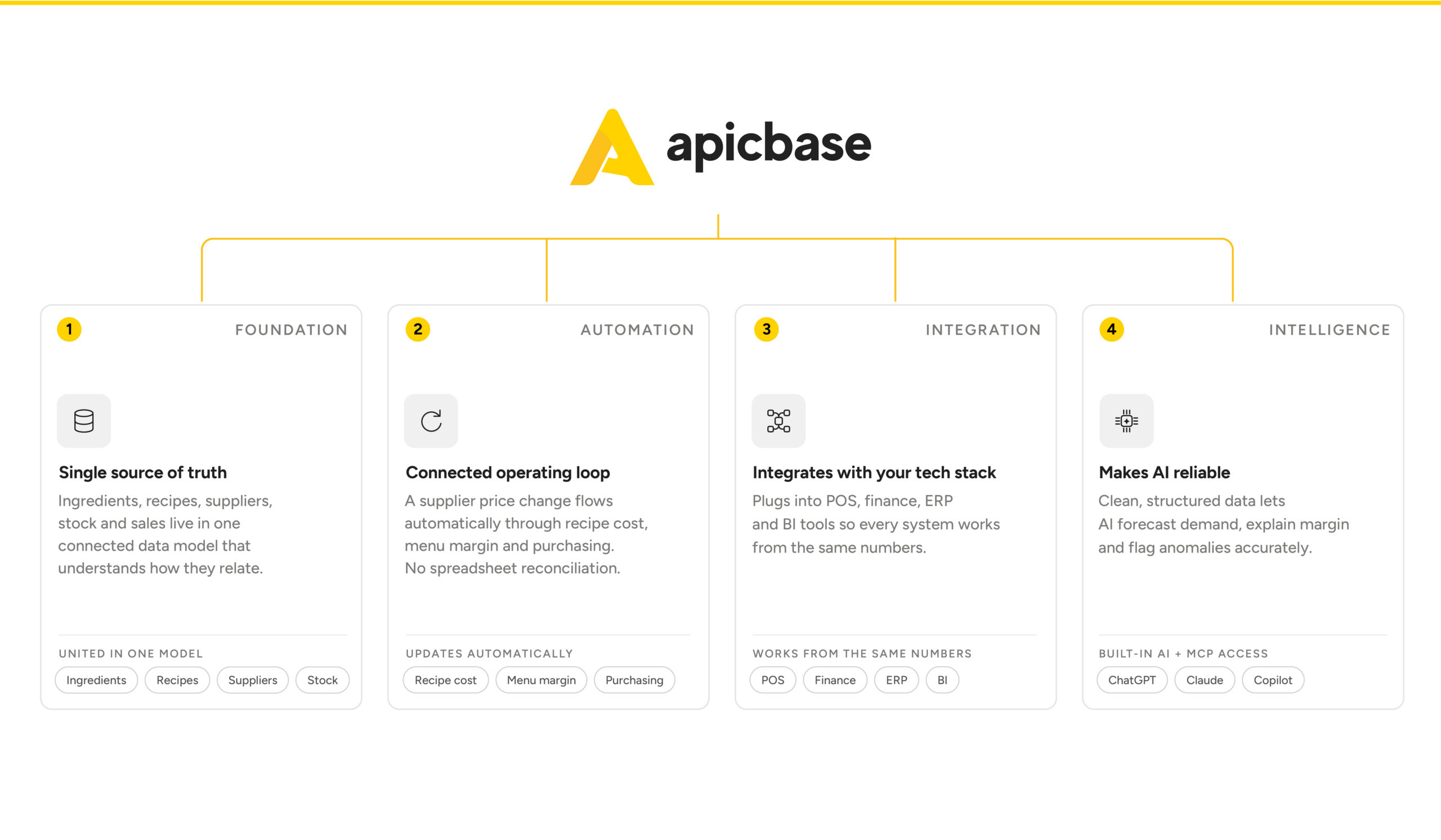
Operators use Apicbase to manage recipes, inventory, purchasing, and food cost in one place.
Apicbase solves the F&B data foundation problem in four ways.
- Single source of truth
Apicbase is the system of record for large and enterprise foodservice operations. Ingredients, supplier items, recipes, prep items, allergens, stock movements, and outlets all reside in a single shared data model.
Supplier items map directly to ingredients. Prep batches can return to inventory. Inventory is automatically depleted when menu items are sold.
Apicbase understands how these entities relate to one another, which creates a governed operational record across every site. - Connected operating loop
Back-of-house operations are not separate workflows. Purchasing affects inventory. Inventory affects recipe cost. Recipe cost affects margin. In Apicbase, that loop is built into the system.
Restaurant staff don’t have to reconcile spreadsheets to understand what’s going on.
When a supplier price changes, the impact flows automatically through recipe costs, menu margins, purchasing decisions, and operational reporting. - Integrated tech stack
Apicbase is not an isolated platform. It connects directly to the broader hospitality technology ecosystem. It can ingest POS sales data so inventory, margin analysis, and forecasting reflect what is actually selling across locations in real time.
It also shares structured F&B data with finance platforms, ERP systems, and BI tools, so every downstream system works from the same data. - The foundation for reliable AI
The data Apicbase generates is structured, connected, and consistent. This allows AI to explain margin movement, suggest purchasing decisions, forecast demand, and surface anomalies — with great accuracy.
Apicbase has built-in AI and an MCP that securely unlocks data for Claude, ChatGPT, Copilot, and other AI tools.

Data is your advantage
AI tools are cheap, powerful, and easy to use. They can produce in minutes what once took teams of analysts weeks. But there’s a catch: the output is only as good as the data behind it. That means the real advantage comes from the data layer, not the AI itself.
Apicbase gives F&B operators that foundation, organising recipe, inventory and compliance data across every location.
With trusted data in place, businesses can have greater confidence in their reporting, operations, and the AI-powered insights built on top of them.
Want to see what that looks like for your business?