
The restaurant industry has spent decades competing against itself. But according to food service analyst Peter Backman, that mental model is now dangerously out of date.
In a recent webinar hosted by Apicbase, Backman — who has tracked the global delivery market since 2012 — laid out a clear-eyed view of how restaurant delivery in Europe is evolving and what multi-site operators need to understand to stay ahead.
Changing competitive landscape
Fifty years ago, the market was simple: restaurants served cooked food on-premises, and retailers sold groceries for cooking at home. Those two worlds rarely collided.
That’s no longer true.
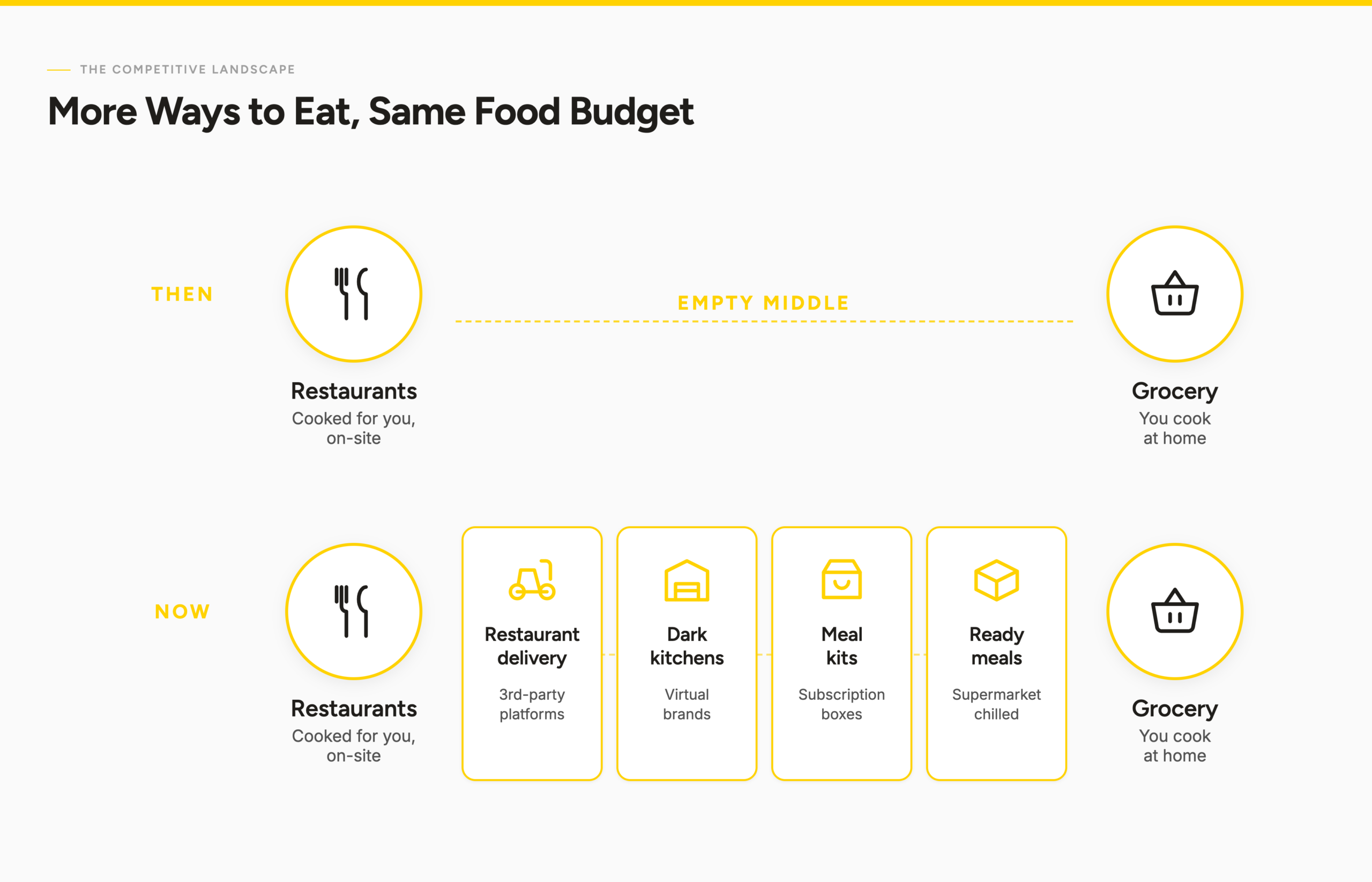
Today, the space between restaurants and retailers is packed with alternatives:
- Meal kit subscriptions
- Supermarket ready meals
- Dark kitchens and virtual brands
- Restaurant delivery via third-party platforms
The lesson here is that no particular element in this space competes in its own area. It’s competing with all the other parts.
Peter Backman, Founder, The Delivery World
For multi-site operators, this is the critical shift. Your guest’s decision to order your food is no longer made in comparison to other restaurants. It’s made against everything else that can put dinner on their table with minimal effort.
Delivery market in Europe
Backman tracks ~15 delivery platforms globally through his Delivery Surge Index. His Q4 2025 data paints a nuanced picture:
- The Middle East and Asia Pacific are growing at roughly 20% per year
- Europe is growing, but slowly, held back by cultural attitudes toward eating out versus eating in, online ordering habits, and tech adoption rates
- The UK is Europe’s most developed delivery market, though consolidation is now limiting the granular data available as Deliveroo and Just Eat have been acquired
At the platform level, Just Eat and Uber Eats lead in European GTV (Gross Transaction Value), while DoorDash operates across the most countries. No two platforms are structured the same. Their market penetration and relationship with restaurants vary considerably by country.
The headline takeaway: the days of doubling market size are over in Europe, but growth remains for operators and platforms willing to build demand together.
Challenges of multi-site operators with delivery platforms
Backman was direct about the tensions built into platform relationships:
- Commission pressure is tough
Restaurants typically operate on thin gross margins. Paying 20–30% in platform commissions, plus additional fees, puts delivery profitability under serious strain.
- You don’t own the customer data
Platforms collect detailed behavioural data on your guests and don’t share it. Your brand becomes what arrives in a brown paper bag — and nothing more.
- Ghost kitchens didn’t scale the way anyone expected
The prediction from five years ago — a ghost kitchen on every street corner — hasn’t materialised. Staff recruitment proved difficult, and the pure-play ghost-kitchen model struggles to achieve profitability.
The more viable version is a restaurant using back-of-house capacity to produce additional virtual brands alongside its main operation.
It’s not unusual for restaurants to be paying well over 30% for each delivery order they receive.
The case for delivery still stands
Despite the friction, Backman’s position is clear: delivery opens a revenue stream worth building.
Key facts from his research:
- Delivery commonly grows to 30% or more of a restaurant’s total sales
- Cannibalisation of dine-in revenue is largely a myth once delivery is normalised. There’s usually a short-term dip when starting out, but it stabilises
- Customers who use delivery apps tend to stay loyal to one app, making platform placement a strategic priority
The question isn’t whether to do delivery. It’s how to structure it.
Key Takeaways for Restaurant Leadership
If your concidering delivery as a new revenue stream or are rethinking the operation you have, here’s what you should walk away with from Backman’s analysis:
- Reframe your competitive set. Your real competition includes meal kits, grocery delivery, and ready meals, not just the restaurant down the street.
- Commission rates demand operational efficiency. At 30%+ per order, delivery can only work if your back-of-house is running lean. This is where technology investment pays back fastest.
- Data asymmetry is a structural disadvantage. White-label ordering tools are gaining interest precisely because operators want their customer data back, but platforms still hold most of the power.
Stay ahead of what’s changing in food service
The delivery landscape is changing with platform consolidation, new commission structures, ghost kitchen pivots, and AI adoption all moving at once.
Keep up with the operators and analysts shaping the industry. The Apicbase blog covers the trends, data, and strategic decisions that matter most to multi-site restaurant leaders.